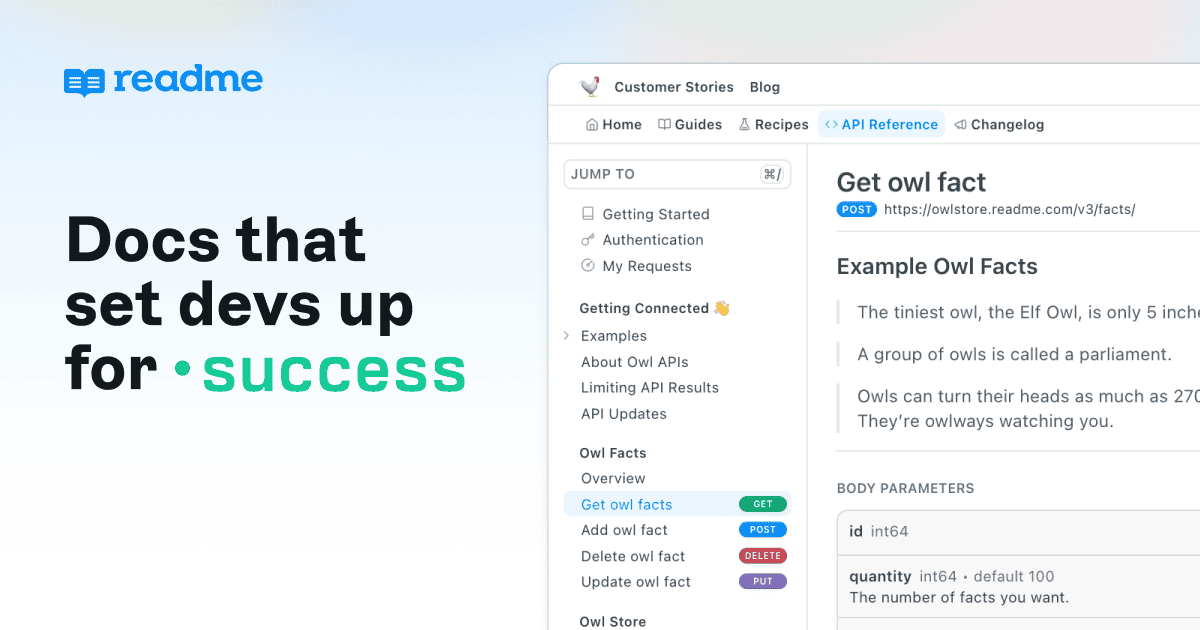

ReadMe is a developer hub platform that transforms API specifications into interactive, personalized documentation that helps developers integrate APIs faster. It goes beyond static documentation by letting users make live API calls from the docs, see personalized code examples with their own API keys, and track their API usage.
The interactive API explorer is ReadMe's most compelling feature. Developers reading the documentation can fill in parameters and execute API requests directly from the docs page, seeing the response in real time. This eliminates the need to switch to a separate tool like Postman for initial API exploration. Code examples are generated in multiple programming languages and, for authenticated users, are personalized with their actual API keys and configuration values. This personalization dramatically reduces time-to-first-call, which is one of the most important metrics for API adoption. ReadMe auto-generates reference documentation from OpenAPI (Swagger) specifications, creating structured endpoint pages with parameter descriptions, response schemas, and error codes. When the API spec is updated, the documentation updates automatically.
Beyond API references, ReadMe supports guides, tutorials, changelogs, and custom pages that together form a complete developer hub. The analytics dashboard provides insights into which endpoints are most used, where developers encounter errors, and which documentation pages are most visited. This data helps API teams prioritize improvements and identify friction points in the developer experience. The platform also supports versioning, allowing teams to maintain documentation for multiple API versions simultaneously.
ReadMe is best suited for companies that offer APIs as a product or as a significant part of their platform. SaaS companies, fintech providers, infrastructure services, and any organization that needs third-party developers to integrate with their API will benefit from ReadMe's interactive approach. Teams building internal-only APIs or general product documentation may find more flexible solutions elsewhere.
The platform offers a free tier for basic API documentation. Paid plans start at a higher price point and add custom branding, analytics, multiple API versions, and enterprise features like SSO and custom domains. Pricing can become significant for organizations with extensive documentation needs and high traffic volumes.
Last updated: July 2026
Key Features
- Interactive API explorer with live requests
- Auto-generated docs from OpenAPI specifications
- Personalized code examples per user
- API usage metrics and developer analytics
- Custom branding and theme support
- Changelog and guide management
Pros
- + Best-in-class interactive API documentation experience
- + Personalized code examples boost developer adoption
- + Usage analytics help understand API consumption
- + Beautiful out-of-the-box design
Cons
- − Pricing can be steep for startups at scale
- − Customization limited compared to building custom docs
- − Focused on APIs — not general documentation
Articles About ReadMe
User Reviews
★
★
★
★
★
4.0 from 4 reviews
KC
Katie Clark
★
★
★
★
★
been using it since the beta. it's gotten so much better. the API doc generation is actually useful now, not just a gimmick
Jul 11, 2026
SW
Sam Wu
★
★
★
★
★
worth every penny. I use it for keeping docs fresh and the quality of suggestions is consistently high
Jun 13, 2026
HT
Helen Torres
★
★
★
★
★
3 months in. works well for what I need. API doc generation is the highlight, wish they'd improve more templates though
May 09, 2026
OC
Olivia C.
★
★
★
★
★
solid 4/5. gets the job done for API docs. would love to see versioning in a future update
Dec 31, 2025
Related Guides
Compare ReadMe






Looking for something different?
View ReadMe Alternatives →