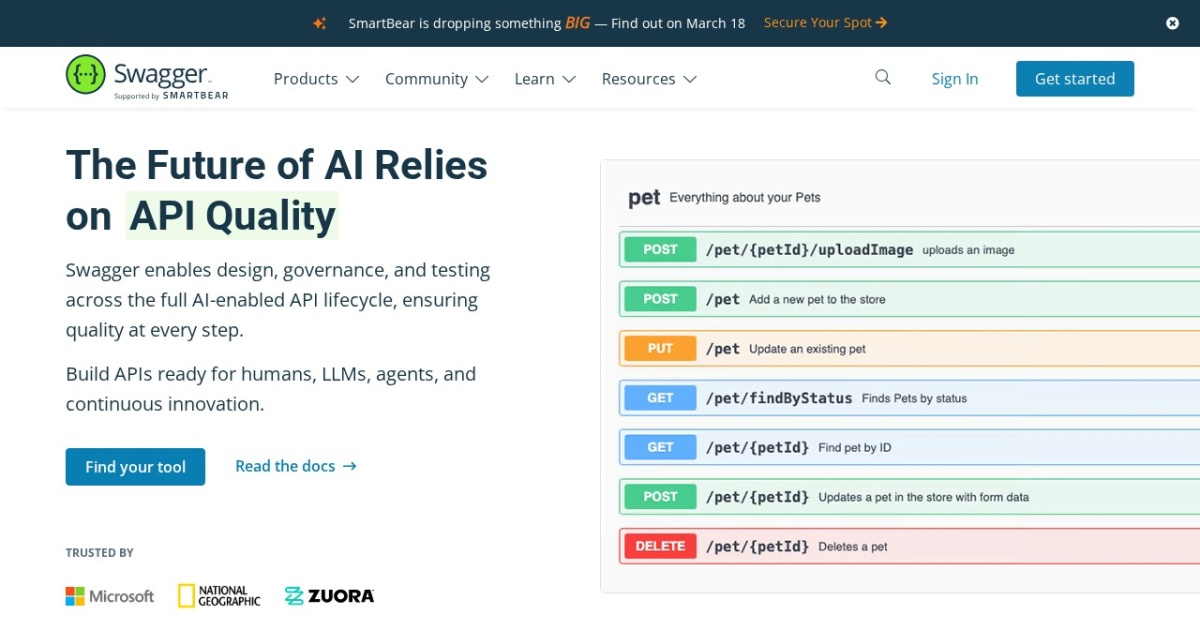

Swagger is a comprehensive suite of API development tools centered around the OpenAPI Specification (formerly known as the Swagger Specification) that enables developers to design, document, and consume RESTful APIs. Now maintained by SmartBear Software, Swagger has become synonymous with API documentation and remains the most widely recognized name in the API tooling ecosystem.
The Swagger toolset comprises several components that cover different stages of the API lifecycle. Swagger Editor provides a browser-based environment for writing and validating OpenAPI specifications in YAML or JSON, with real-time error highlighting and a live documentation preview. Swagger UI generates interactive API documentation from an OpenAPI spec, allowing users to explore endpoints, view request and response schemas, and execute live API calls directly from the documentation page. Swagger Codegen automates the generation of server stubs and client SDKs in dozens of programming languages, reducing the boilerplate work of integrating with an API. Together, these tools support an API-first development approach where the specification drives both the implementation and the documentation.
Swagger's tools are best suited for backend developers, API architects, and teams building RESTful services that need to be consumed by other developers, whether internal or external. The interactive documentation produced by Swagger UI is particularly valuable for public APIs, as it lowers the barrier for third-party developers to understand and integrate with an API. Enterprises managing large API portfolios benefit from SwaggerHub, which adds team collaboration, API governance, and centralized management on top of the open-source tools.
The core Swagger tools, including Swagger Editor, Swagger UI, and Swagger Codegen, are free and open-source. SwaggerHub, the commercial collaboration platform, offers a free tier for individual use and paid plans starting at $75 per month per project for teams that need centralized API management, style validation, and organizational controls. For many teams, the free open-source tools are sufficient for API documentation needs, while SwaggerHub serves organizations requiring tighter governance over their API specifications and design standards.
Last updated: July 2026
Key Features
- Swagger Editor for API design
- Swagger UI for interactive API documentation
- Code generation for server and client SDKs
- OpenAPI Specification support (3.0 and 3.1)
- API testing and validation
- SwaggerHub for team collaboration
Pros
- + Industry standard for API documentation
- + Free and open-source core tools
- + Interactive docs that let users try API calls
- + Massive ecosystem of supporting tools
Cons
- − SwaggerHub collaboration features require paid plan
- − Can be verbose for complex API schemas
- − UI customization is limited without forking
User Reviews
★
★
★
★
★
3.8 from 2 reviews
VK
Victor K.
★
★
★
★
★
better than most options out there for knowledge bases. search is my only real complaint
May 16, 2026
DZ
Daniel Zhang
★
★
★
★
★
solid choice if you need it for knowledge bases. compared to alternatives the API doc generation is better here
Mar 09, 2026
Related Guides
Compare Swagger






Looking for something different?
View Swagger Alternatives →