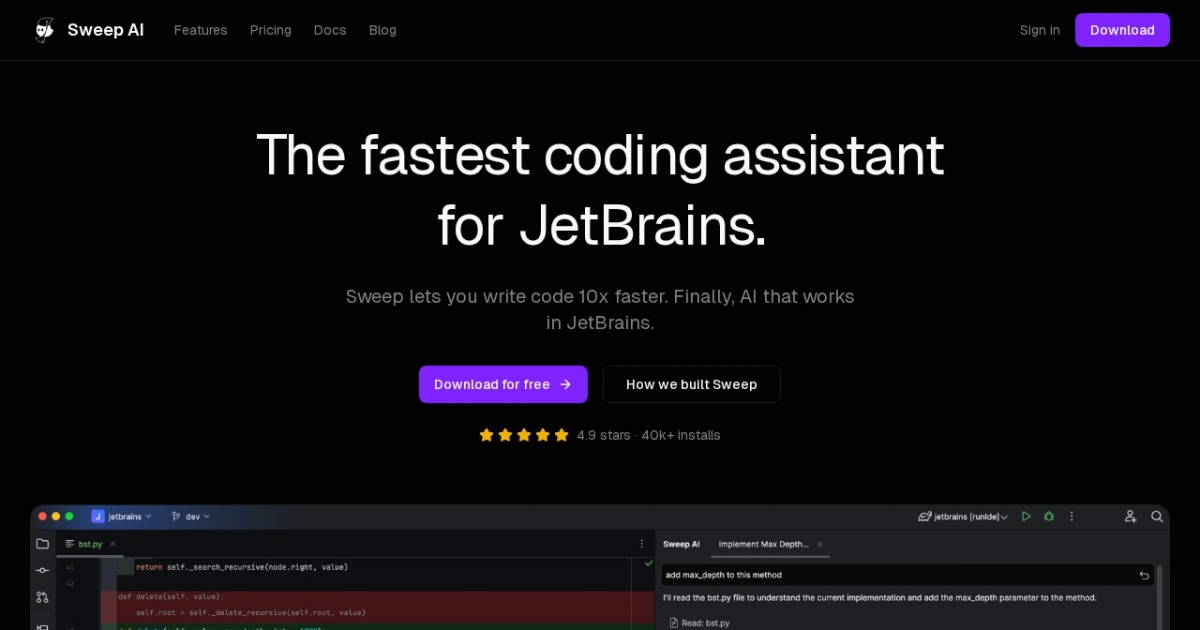

Sweep is an AI-powered development tool that automatically converts GitHub issues into pull requests, acting as an AI junior developer that handles routine coding tasks within your existing GitHub workflow. When you tag an issue with the Sweep label or mention Sweep in an issue, it reads your codebase, plans the necessary changes, writes the code, and opens a pull request for your team to review.
Sweep's integration with GitHub is its defining characteristic. Rather than introducing a new tool or interface, it works within the workflow developers already use. Create a GitHub issue describing a bug fix, small feature, or refactoring task, and Sweep handles the implementation. It reads the relevant files in your repository, understands the project structure and coding patterns, generates the appropriate code changes, and creates a pull request with a clear description of what was changed and why. When reviewers leave comments on the PR, Sweep can iterate on the feedback, making additional changes based on review suggestions. This makes it feel less like an AI tool and more like a responsive team member who is always available to pick up routine tickets. Sweep can also be configured with rules that define coding standards, preferred patterns, and project-specific conventions that it should follow when generating code.
Sweep is best suited for development teams with a steady backlog of well-defined, routine tasks that do not require senior-level judgment. It handles bug fixes, simple feature additions, test coverage expansion, documentation updates, and code cleanup effectively. Open-source project maintainers find it particularly useful for addressing contributor issues and keeping their backlog manageable. Teams that follow a disciplined issue-tracking workflow with clear, specific issue descriptions get the best results.
A free tier is available for open-source projects, with paid plans for private repositories and teams. The primary limitation is that Sweep is exclusively a GitHub tool, with no support for GitLab, Bitbucket, or other code hosting platforms. Task complexity is another boundary: Sweep works well for tasks that a junior developer could complete with clear instructions, but struggles with complex architectural changes, ambiguous requirements, or tasks that require deep domain knowledge. Quality of output correlates directly with the clarity and specificity of the issue description.
Last updated: July 2026
Key Features
- Converts GitHub issues into pull requests automatically
- Full codebase understanding for context-aware changes
- Handles bug fixes, refactors, and small features
- Iterates on PR feedback from code reviews
- Integrates directly with GitHub workflows
- Configurable rules for code style and patterns
Pros
- + Seamless GitHub integration — works like a team member
- + Great for routine tasks that don't need senior attention
- + Iterates on review feedback automatically
- + Free tier available for open-source projects
Cons
- − Limited to GitHub — no GitLab or Bitbucket support
- − Struggles with complex architectural changes
- − Quality varies significantly by task complexity
User Reviews
★
★
★
★
★
3.6 from 4 reviews
KS
Katie Sterling
★
★
★
★
★
good not great. the PR generation is excellent but I feel like transparency should be a priority for them
May 22, 2026
MC
Mark C.
★
★
★
★
★
3 months in. works well for what I need. PR generation is the highlight, wish they'd improve error handling though
Mar 29, 2026
MZ
Mike Zhang
★
★
★
★
★
solid choice if you need it for automating grunt work. compared to alternatives the PR generation is better here
Mar 16, 2026
DR
Derek R.
★
★
★
★
★
pretty good. saves me time on complex refactors most days. the autonomous mode feature is the main reason I stick around
Dec 24, 2025
Related Guides
Compare Sweep





Looking for something different?
View Sweep Alternatives →