
GitHub Actions
CI/CD automation built directly into GitHub for seamless workflows.
GitHub Actions is GitHub's integrated CI/CD platform that allows developers to automate software workflows directly from their repositories. It responds to GitHub events such as pushes, pull requests, issue creation, and scheduled triggers, making it possible to build, test, deploy, and perform virtually any automated task without leaving the GitHub ecosystem.
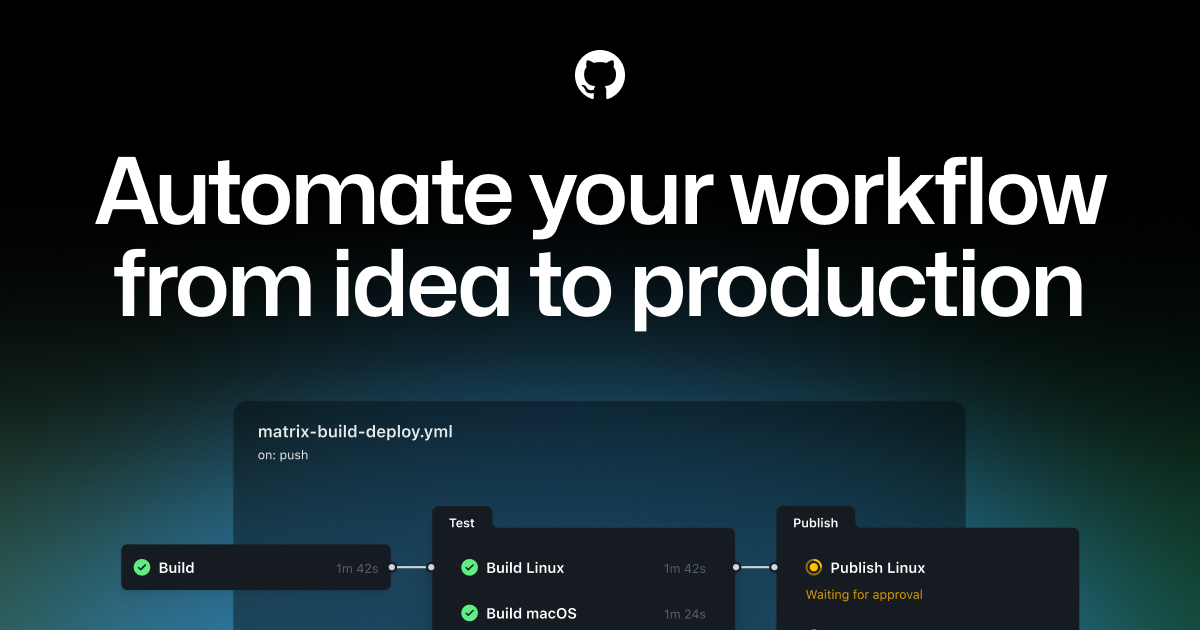
The platform's core advantage is its native integration with GitHub. There is no external service to configure, no webhooks to set up, and no separate authentication to manage. Workflow files live in the repository alongside the code they automate, making them version-controlled and reviewable through pull requests. The GitHub Actions Marketplace contains thousands of pre-built actions contributed by the community and vendors, covering tasks from running linters and deploying to AWS to sending Slack notifications and creating releases. Matrix builds allow workflows to test across multiple operating systems, language versions, and configurations in parallel, which is valuable for open-source libraries that need broad compatibility. Self-hosted runners give teams the option to execute workflows on their own hardware for performance-sensitive or compliance-driven workloads.
GitHub Actions is the default CI/CD choice for the vast majority of projects hosted on GitHub, which makes it ideal for open-source maintainers, individual developers, and teams already invested in the GitHub platform. Enterprise teams benefit from environment protection rules, required reviewers for deployments, and integration with GitHub's security features like Dependabot and code scanning. The platform scales from simple linting checks on pull requests to complex multi-stage deployment pipelines.
GitHub Actions is free for public repositories with generous monthly limits. Private repositories receive a baseline of free minutes per month depending on the GitHub plan, with additional minutes billed per minute of usage. Linux runners are the most cost-effective, while macOS and Windows runners consume minutes at higher rates. Organizations with high build volumes should evaluate costs against alternatives like self-hosted runners or dedicated CI/CD platforms. Despite its YAML-based configuration, which can become verbose for complex workflows, GitHub Actions has become the most widely used CI/CD platform due to its zero-friction setup and deep GitHub integration.
Last updated: March 2026
Key Features
- CI/CD automation triggered by GitHub events
- Marketplace with thousands of pre-built actions
- Matrix builds for multi-platform testing
- Container and VM-based runners
- Self-hosted runner support
- Secrets management and environment protection
Pros
- + Native GitHub integration — zero setup friction
- + Massive action marketplace for any workflow
- + Free for public repositories
- + Self-hosted runners for custom environments
Cons
- − YAML configuration can be verbose and complex
- − Debugging failed workflows is less convenient than CircleCI
- − Minutes-based pricing for private repos can add up
User Reviews
★
★
★
★
★
4.3 from 3 reviews
MZ
Maya Zhang
★
★
★
★
★
good tool, use it daily. IaC support works well. only wish k8s support was better but overall solid
Jun 10, 2026
KS
Katie Scott
★
★
★
★
★
solid tool. nothing flashy but it reliably does what it says. especially good for CI/CD
Apr 21, 2026
NK
Nina Kim
★
★
★
★
★
really good for provisioning. I've tried the alternatives and this handles edge cases way better
Jan 06, 2026
Related Guides
Compare GitHub Actions






Looking for something different?
View GitHub Actions Alternatives →