
LogRocket
Session replay and error tracking to understand what users experienced.
LogRocket is a frontend monitoring platform that combines session replay, error tracking, and product analytics to give developers complete context around user-facing issues. Rather than relying solely on error logs and stack traces, LogRocket lets teams watch a pixel-perfect replay of exactly what a user experienced, transforming debugging from an exercise in speculation into one of observation.
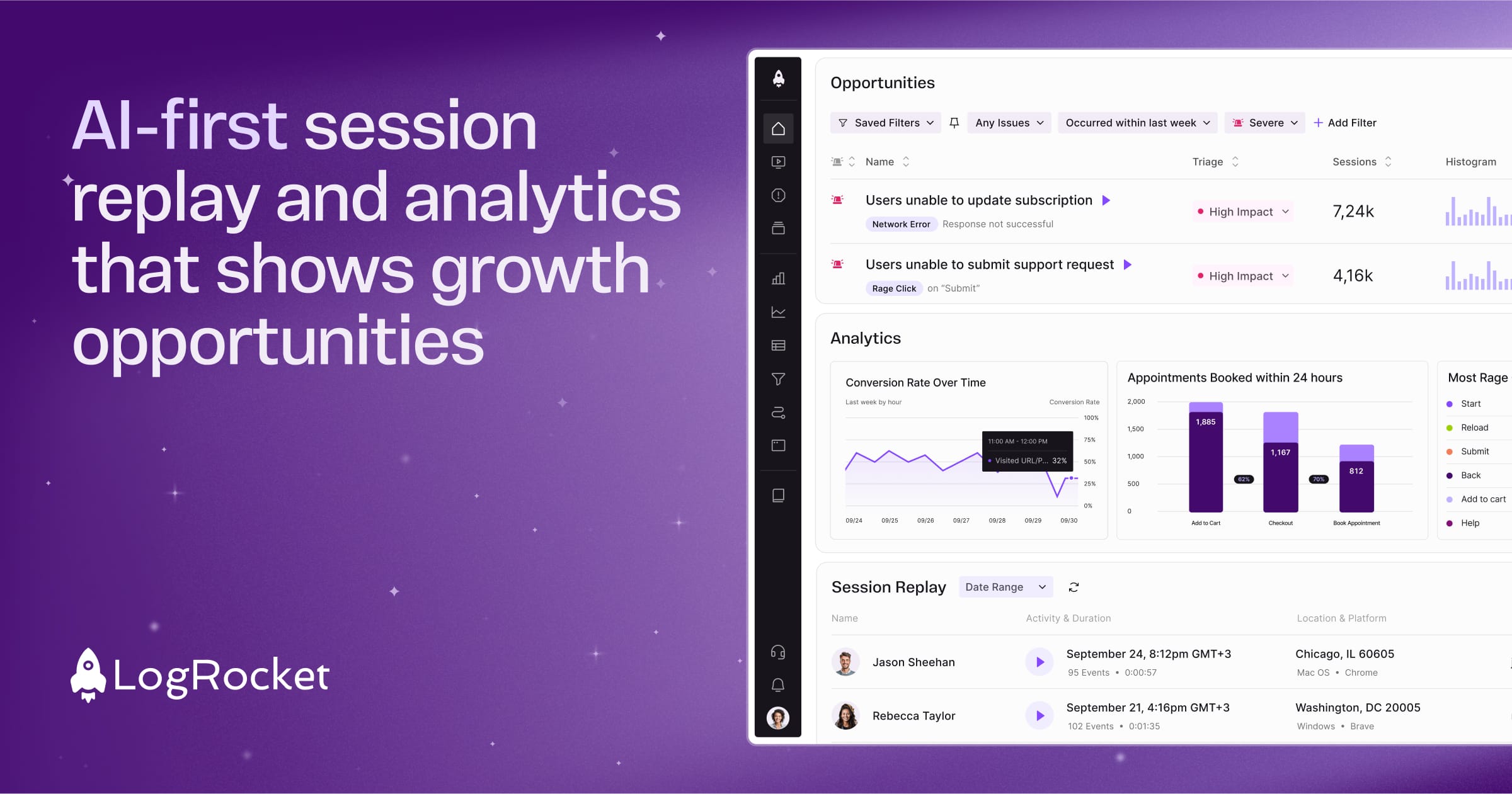
The platform records user sessions and captures a detailed timeline of DOM changes, console logs, network requests and responses, Redux and Vuex state mutations, and JavaScript errors. When an issue is reported, developers can jump directly to the session where it occurred and see the exact sequence of user actions, API responses, and state transitions that led to the problem. LogRocket also includes proactive monitoring features like rage click detection and frustration scoring, which surface UX problems that users may never formally report but that hurt engagement and retention. Additionally, the platform tracks Core Web Vitals and other performance metrics, tying performance data directly to individual sessions so that teams can see how slow load times or layout shifts affect real user behavior.
LogRocket is best suited for frontend and full-stack development teams working on web applications where user experience is a primary concern. Product teams find it particularly valuable because session replays serve double duty as both debugging tools and user research data. Engineering teams at SaaS companies, e-commerce platforms, and any organization where user-facing bugs have a direct revenue impact will see the most return from LogRocket. It integrates with error tracking tools like Sentry and Bugsnag, issue trackers like Jira and Linear, and analytics platforms, fitting into existing workflows rather than replacing them.
The platform offers a free tier with limited session recording and retention, making it accessible for evaluation. Paid plans increase session volume, retention periods, and unlock features like advanced search and team collaboration. Teams should be aware that session recording does add a small performance overhead to the client, and data volumes can grow quickly on high-traffic applications, which affects cost. Privacy considerations also warrant attention, as recording user sessions requires thoughtful configuration of data sanitization to avoid capturing sensitive information.
Last updated: July 2026
Key Features
- Session replay with pixel-perfect fidelity
- Error tracking with full session context
- Network request and response logging
- Redux, Vuex, and NgRx state inspection
- Performance monitoring and Core Web Vitals
- Rage click and frustration signal detection
Pros
- + Session replay eliminates guesswork in debugging
- + Combines error tracking with user experience context
- + Frustration detection highlights UX issues proactively
- + Free tier for getting started
Cons
- − Session recording adds some performance overhead
- − Data volume can drive up costs quickly
- − Privacy concerns with recording user sessions
User Reviews
★
★
★
★
★
4.0 from 2 reviews
TR
Tyler R.
★
★
★
★
★
pretty good. saves me time on tracking down bugs most days. the stack trace analysis feature is the main reason I stick around
Mar 20, 2026
3 found this helpful
NN
Nina N.
★
★
★
★
★
pretty good. saves me time on prod debugging most days. the profiling feature is the main reason I stick around
May 07, 2026
Related Guides
Compare LogRocket





Looking for something different?
View LogRocket Alternatives →