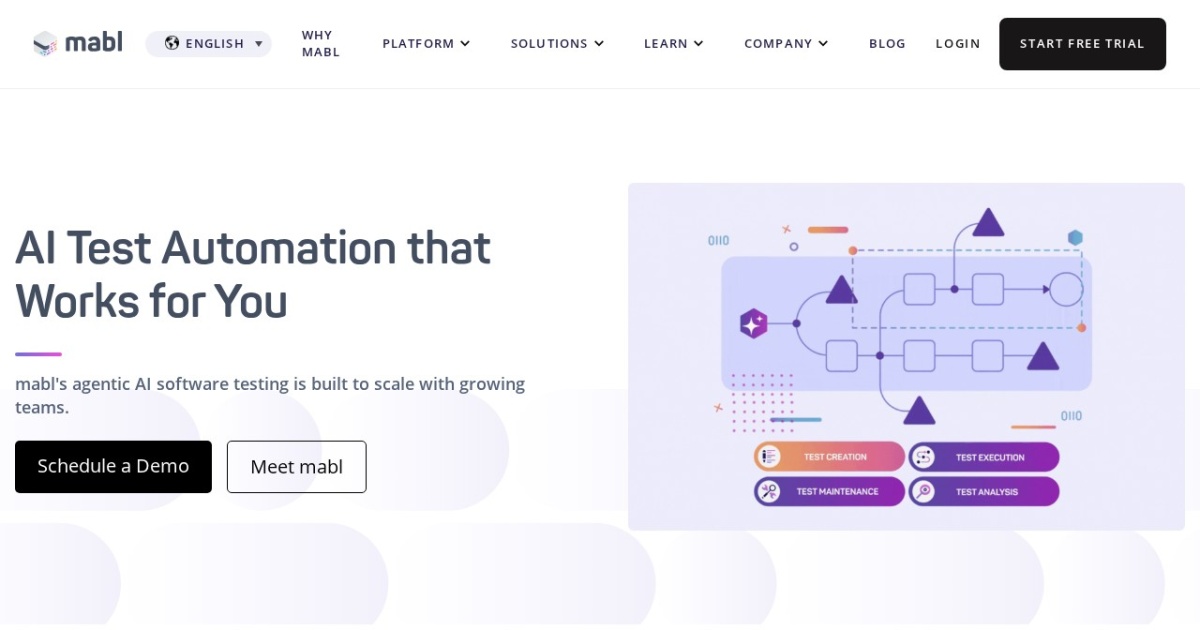

Mabl is an intelligent test automation platform that uses AI to simplify the creation, execution, and maintenance of end-to-end tests for web applications, featuring auto-healing capabilities that automatically update tests when the application's UI changes, reducing the maintenance burden that typically makes end-to-end testing unsustainable at scale.
Mabl's auto-healing technology is its primary differentiator. When a UI element changes -- a button moves, a class name updates, or a form field is restructured -- Mabl automatically detects the change and updates the test to accommodate it, rather than failing with a broken selector. The platform reports these adaptations so teams can review what changed, but the tests continue to run without manual intervention. This capability addresses the fundamental challenge that causes many teams to abandon end-to-end testing: the tests break faster than the team can fix them. Mabl also provides unified testing across multiple testing types in a single platform, including functional UI testing, API testing, accessibility testing, and performance testing.
Test creation in Mabl uses a low-code visual approach where you walk through the application and record steps, add assertions, and define test flows. The platform supports parameterized tests, reusable flows that can be shared across test suites, and conditional logic for complex scenarios. Tests run in the cloud across multiple browsers and devices, with results presented in a dashboard that includes screenshots, video recordings, and detailed logs for each step. The CI/CD integration allows tests to run automatically on every deployment, providing continuous quality assurance throughout the development lifecycle.
Mabl is best suited for QA teams and engineering organizations that need reliable, low-maintenance end-to-end testing and are willing to invest in a dedicated testing platform. It is particularly appealing to teams that have struggled with test maintenance using open-source frameworks like Selenium or Playwright. Mabl does not offer a free tier -- pricing starts at approximately $40 per month and scales based on the number of tests, execution frequency, and team size. This makes it a more significant investment than open-source alternatives, but teams that have experienced the cost of maintaining brittle test suites often find the reduction in maintenance time justifies the expense. Complex test scenarios that require extensive custom logic may require workarounds within Mabl's framework.
Last updated: July 2026
Key Features
- AI-powered auto-healing test maintenance
- Low-code test creation with visual editor
- Unified UI, API, and accessibility testing
- Performance testing and monitoring
- CI/CD pipeline integration
- Cross-browser and cross-device testing
Pros
- + Auto-healing tests reduce maintenance burden significantly
- + Unified testing across multiple testing types
- + Low-code approach accessible to non-developers
- + Strong CI/CD integration for continuous testing
Cons
- − No free tier — paid subscription required
- − Can be expensive for larger teams
- − Complex test scenarios may require workarounds
User Reviews
★
★
★
★
★
4.2 from 3 reviews
AC
Alicia C.
★
★
★
★
★
3 months in. works well for what I need. security scanning is the highlight, wish they'd improve monorepo support though
Apr 25, 2026
3 found this helpful
PP
Patrick P.
★
★
★
★
★
our team of 6 adopted this last quarter. everyone loves it. biggest win is test generation — catches stuff we'd miss in review
May 07, 2026
SM
Simone M.
★
★
★
★
★
huge fan. the CI integration is what got me hooked but the whole experience is really polished
Feb 20, 2026
Compare Mabl




Looking for something different?
View Mabl Alternatives →